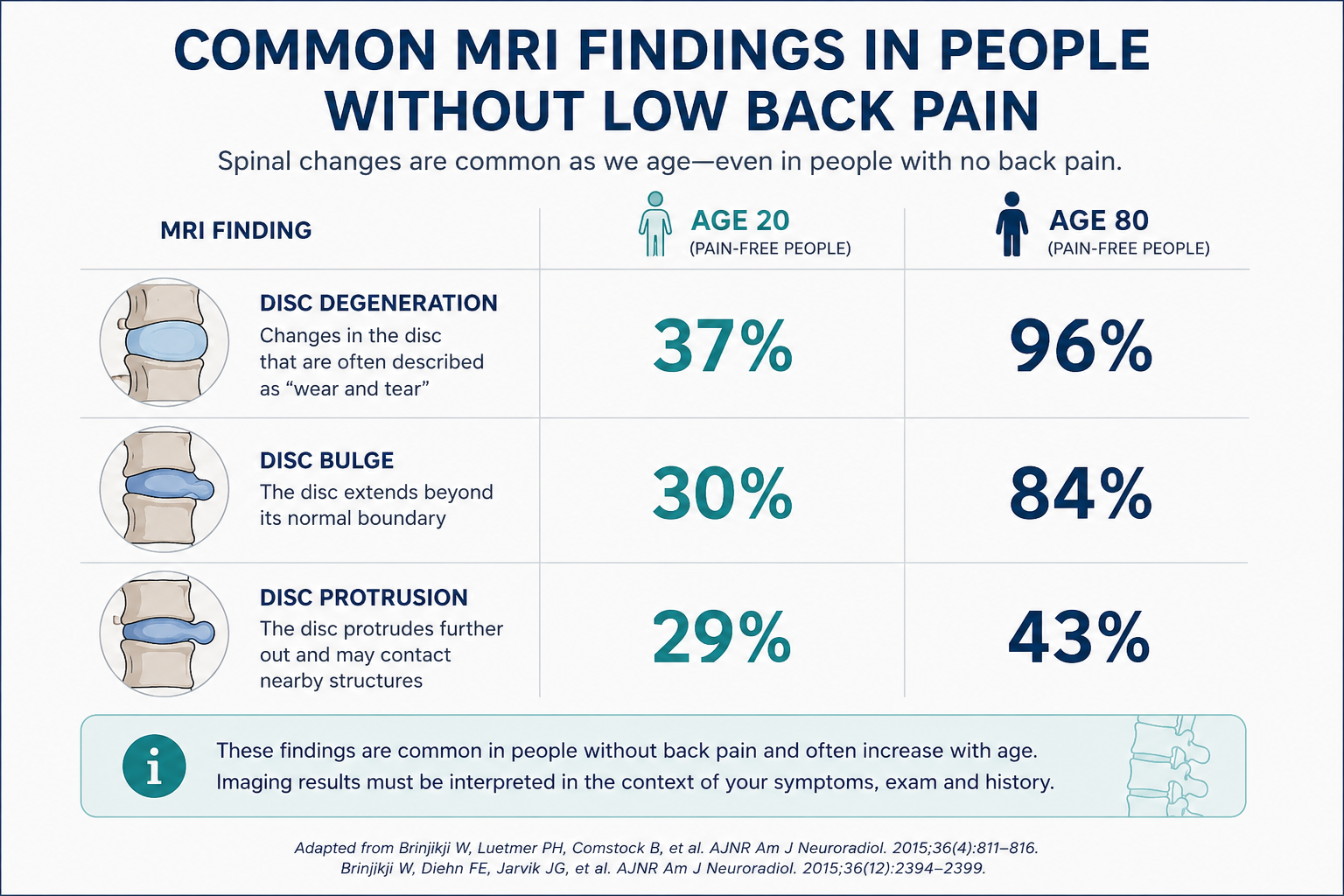
An MRI can provide detailed images of the spine, but it cannot always determine why someone is experiencing pain.
A well-known systematic review examined spinal imaging from 3,110 people who did not have back pain. The researchers found that:
Disc degeneration was present in 37% of pain-free 20-year-olds and 96% of pain-free 80-year-olds.
Disc bulges were present in 30% of pain-free 20-year-olds and 84% of pain-free 80-year-olds.
Disc protrusions were present in 29% of pain-free 20-year-olds and 43% of pain-free 80-year-olds.[5]
These findings demonstrate that changes described as degeneration, bulging or wear and tear can be present in people without pain and often become more common with age.
This does not mean that MRI findings are meaningless. A related systematic review found that some findings, including disc degeneration, bulges, protrusions and certain bone-marrow changes, were more common in adults with low back pain than in people without pain.[6]
The important point is that imaging findings must be interpreted in context.
A scan should be considered alongside:
The location and behaviour of symptoms
The presence of leg pain
Strength, reflex and sensation testing
Functional limitations
Medical history
Physical examination findings
Current guidelines recommend against routinely ordering imaging for uncomplicated acute low back pain unless there are signs of a serious condition or the imaging result is likely to change treatment.[1,3]
Finding a disc bulge on an MRI does not necessarily mean that it is the source of the pain, that the spine is damaged or that normal activity should be permanently avoided.
What can you do during a recent flare-up?
During a recent flare-up, it is reasonable to temporarily reduce or modify an activity that is especially painful. However, prolonged bed rest and complete avoidance of movement are generally discouraged.
Current guidance recommends remaining physically active and continuing normal daily activities with modifications when necessary.[1–3]
This does not mean forcing your way through severe pain. It means finding a manageable amount of movement while symptoms settle.
Helpful strategies may include:
Taking short, comfortable walks
Changing positions regularly
Continuing normal tasks at a reduced pace
Temporarily reducing the weight or volume of lifting
Dividing larger tasks into shorter periods
Gradually increasing activity as symptoms improve
For example, several short walks may be better tolerated than one long walk. A lifting task may be manageable with a lighter load, fewer repetitions or more frequent breaks rather than avoiding lifting completely.
A movement does not always need to be completely pain-free. However, it may need to be modified if it causes rapidly escalating pain, worsening symptoms farther down the leg, new weakness or a substantial increase in symptoms that does not settle afterward.
Heat may provide short-term relief
A heating pad, heat wrap or warm shower may provide short-term pain relief and make movement feel more comfortable during a recent flare-up.[1]
Heat should be comfortably warm rather than excessively hot. Protect your skin and follow the product’s safety instructions.
Heat is most useful when it helps you remain mobile, sleep more comfortably or participate in your rehabilitation plan.
Medication may be appropriate for some people
Nonsteroidal anti-inflammatory drugs, commonly called NSAIDs, may provide short-term pain relief for some people with acute low back pain.[1,3]
However, these medications are not appropriate for everyone. Their suitability may depend on other medications and a person’s stomach, kidney, cardiovascular and general health history.
Speak with a pharmacist or physician if you are uncertain whether a medication is safe or appropriate for you.
Medication is generally most useful when it supports sleep, movement and normal activity rather than acting as the only treatment strategy.
What can you expect from physiotherapy?
Physiotherapy is not one specific exercise or treatment technique. Evidence-informed physiotherapy combines assessment, education, symptom-management strategies and progressive rehabilitation based on the individual.
A low back assessment should begin with your story rather than simply measuring posture or searching for tight muscles.
Depending on your symptoms, an assessment may include:
How and when the pain began
The location and behaviour of your symptoms
Whether pain, numbness or tingling travels into the leg
Strength, reflex and sensation testing when appropriate
Back, hip and lower-limb movement
Positions or movements that improve or aggravate symptoms
Tolerance for bending, lifting, sitting, standing and walking
Previous episodes and treatment
Work, exercise and recreational demands
Your goals and concerns
The purpose is not always to identify one exact painful tissue. In many cases, that is neither possible nor necessary.
The purpose is to screen for important concerns, understand the overall pattern, identify factors that can be changed and develop a practical recovery plan.
Depending on the assessment, treatment may include:
A clear explanation of the findings
Strategies for reducing and managing pain
Advice for modifying painful activities
Exercises selected for your symptoms and goals
Progressive strength, endurance or mobility training
Gradual exposure to bending, lifting or other sensitive movements
Manual therapy or dry needling when appropriate
Planning for a return to work, exercise or sport
A strategy for managing future flare-ups
Current physiotherapy guidelines support exercise, movement training, education and selected forms of manual therapy for people with low back pain.[4]
Progress should also be measured by more than pain alone. Meaningful improvements may include walking farther, sleeping better, sitting longer, returning to exercise, lifting with greater confidence or feeling less worried about movement.
Is there a best exercise for low back pain?
Despite what social media may suggest, there is no single exercise that is best for everyone.
Current clinical guidelines support several exercise approaches for persistent or recurring low back pain, including:
General strengthening
Trunk strengthening and endurance exercise
Aerobic exercise
Movement-control exercise
Aquatic exercise
Individually designed exercise programs
Gradual exposure to activities that have become painful or concerning
A large Cochrane review involving 249 trials found moderate-certainty evidence that exercise produced a clinically important average improvement in pain compared with no treatment, usual care or placebo in people with chronic low back pain.[8]
Exercise may help by:
Reducing pain
Improving strength and physical capacity
Increasing confidence in movement
Making work and recreational activities easier
Improving general health and conditioning
Preparing the body for bending, lifting and other daily demands
Reducing the impact of future episodes
The best exercise program is one that is appropriately matched to your symptoms, current ability and goals.
Someone returning to golf may require a different program than someone having difficulty sitting at work, caring for a child, running or lifting at a physical job.
What about core strengthening?
Core exercises can be helpful, but back pain does not normally mean that the core has switched off or that the spine is unstable.
Trunk strengthening and movement-control exercises are supported treatment options, particularly for persistent low back pain.[4] They may improve strength, coordination, confidence and tolerance for movement.
However, core exercises should not necessarily remain the entire rehabilitation program.
As symptoms improve, rehabilitation should progress toward the activities you need or want to perform. This may include:
Bending and reaching
Carrying groceries
Lifting from the floor
Gardening
Running
Golfing
Returning to the gym
Meeting the physical demands of work
The goal is not to keep the spine rigid or protected indefinitely. The goal is to gradually restore its ability to move and tolerate the demands of everyday life.
Does posture cause low back pain?
There is no single correct posture that everyone must maintain.
Current evidence does not support the idea that one specific spinal posture consistently causes low back pain for everyone.[7] However, certain positions can still aggravate an already sensitive back.
Sitting may be uncomfortable for one person, while standing or walking may be more provocative for another. This does not necessarily mean that the position is damaging the spine.
Rather than trying to hold one perfect posture, it is often more useful to:
Change positions periodically
Use a comfortable setup for the task
Take breaks from prolonged positions
Gradually improve tolerance to difficult positions
Avoid becoming unnecessarily rigid or guarded
The same principle applies to bending. Bending the spine is a normal part of daily life. It may need to be modified temporarily when symptoms are highly sensitive, but it does not normally need to be permanently avoided.
Physiotherapy can help determine how to gradually reintroduce positions and movements that have become uncomfortable.
Why can low back pain persist?
Persistent pain is real, but pain intensity does not always provide a direct measurement of tissue damage.
In some people, increased sensitivity, protective movement patterns, disrupted sleep, stress, reduced conditioning and concern about reinjury can all contribute to ongoing pain and disability.
Muscles may remain guarded, normal movements may feel threatening and activities may be avoided because of concern about making the condition worse.
This does not mean that pain is imaginary or “all in your head.” It means that pain can be influenced by several interacting biological, psychological and social factors rather than only the condition of one spinal structure.
The World Health Organization recommends person-centred treatment for chronic primary low back pain that considers the combination of physical, psychological and social factors affecting the person. Recommended care may include education, structured exercise and psychologically informed rehabilitation.[2]
The RESTORE randomized controlled trial studied adults with chronic, disabling low back pain. Individualized cognitive functional therapy produced greater and sustained improvements in activity limitations than usual care.[10]
The treatment involved helping participants to:
Better understand their pain
Gradually return to meaningful activities
Address protective or guarded movement patterns
Build confidence in their bodies
Modify relevant lifestyle and recovery factors
Not every person requires this particular treatment method. However, the study shows that a specific individualized, physiotherapy-led approach can produce meaningful and sustained improvements for some people with chronic disabling low back pain.
Why does low back pain keep coming back?
Recurrence is common. A flare-up does not necessarily mean that the spine has been reinjured or that previous treatment has failed.
Recurrences may occur after:
A sudden increase in lifting or exercise
A period of reduced activity
Returning to full activity before capacity has been rebuilt
Prolonged or unfamiliar activity
Poor sleep, stress or illness
Sometimes a flare-up also occurs without one clearly identifiable cause.
An effective rehabilitation plan should do more than settle the current episode. It should help you understand how to respond if symptoms return and build the physical capacity required for the activities that matter to you.
The 2024 WalkBack randomized controlled trial studied 701 adults who had recently recovered from an episode of nonspecific low back pain. An individualized walking and education program delivered by physiotherapists reduced the risk of another activity-limiting episode by approximately 28% compared with no intervention.[9]
The median time before a recurrence was 208 days in the walking and education group, compared with 112 days in the control group.[9]
This provides encouraging evidence that a simple and progressive activity plan can help some people remain active and reduce the impact of future episodes.
What role do manual therapy and dry needling play?
Hands-on treatment may provide short-term pain relief and help some people move more comfortably.
The current physiotherapy guideline supports joint mobilization or manipulation for selected people with acute or chronic low back pain. Soft-tissue treatment may also help reduce pain in the short term.[4]
Dry needling may be considered alongside other treatments for short-term pain relief in selected people with chronic low back pain.[4]
These treatments are generally most useful when they support an active rehabilitation plan. For example, reducing pain may make it easier to walk, exercise, sleep or practise a previously difficult movement.
At Northstar Physiotherapy, manual therapy or dry needling may be included when appropriate, when desired by the patient and when it helps progress toward an identified goal.
When manual therapy or dry needling is used, it is framed as a tool for symptom relief and improved movement rather than as a permanent structural correction.
The longer-term goal is to improve your movement, strength, confidence and ability to manage the condition independently.
When should you consider booking an assessment?
A physiotherapy assessment may be helpful when:
Pain is limiting work, sleep, exercise or normal activity
Symptoms travel into the buttock or leg
You are experiencing numbness, tingling or weakness
The problem is not gradually improving
You have repeated episodes and are unsure how to manage them
You are uncertain which movements or activities are safe
You want a structured plan for returning to lifting, running, golf or another activity
Previous treatment provided only temporary relief
You do not need to wait until the pain becomes severe or until you have had an MRI.
A practical way forward
Low back pain rarely has one universal explanation or one perfect exercise.
The most consistent message across modern clinical guidelines is to begin with an appropriate assessment, screen for uncommon conditions requiring medical care, remain active where possible and use an individualized combination of education, symptom management and progressive rehabilitation.[1–4]
During a recent flare-up, heat, temporary activity modifications and appropriate medication may help make symptoms more manageable. Manual therapy or dry needling may provide additional short-term relief for selected people.
Physiotherapy can then help you move beyond symptom relief by restoring movement, improving strength and capacity, building confidence and preparing you for the activities you want to return to.
At Northstar Physiotherapy in Calgary, appointments are private and one-on-one. This provides time to understand your symptoms, answer your questions and develop a treatment plan based on your individual needs and goals.
Book a 60-minute physiotherapy assessment if low back pain is limiting your daily activity or you are unsure how to move forward safely.
This article provides general educational information and does not replace an individualized medical or physiotherapy assessment.
References
Ontario Health. Low Back Pain: Care for Adults With Acute Low Back Pain. Toronto: Ontario Health; 2025.
World Health Organization. WHO Guideline for Non-Surgical Management of Chronic Primary Low Back Pain in Adults in Primary and Community Care Settings. Geneva: World Health Organization; 2023.
Department of Veterans Affairs and Department of Defense. VA/DoD Clinical Practice Guideline for the Diagnosis and Treatment of Low Back Pain. Version 3.0; 2022.
George SZ, Fritz JM, Silfies SP, et al. Interventions for the management of acute and chronic low back pain: revision 2021. Journal of Orthopaedic & Sports Physical Therapy. 2021;51(11):CPG1–CPG60. doi:10.2519/jospt.2021.0304.
Brinjikji W, Luetmer PH, Comstock B, et al. Systematic literature review of imaging features of spinal degeneration in asymptomatic populations. American Journal of Neuroradiology. 2015;36(4):811–816. doi:10.3174/ajnr.A4173.
Brinjikji W, Diehn FE, Jarvik JG, et al. MRI findings of disc degeneration are more prevalent in adults with low back pain than in asymptomatic controls: a systematic review and meta-analysis. American Journal of Neuroradiology. 2015;36(12):2394–2399. doi:10.3174/ajnr.A4498.
Swain CTV, Pan F, Owen PJ, Schmidt H, Belavy DL. No consensus on causality of spine postures or physical exposure and low back pain: a systematic review of systematic reviews. Journal of Biomechanics. 2020;102:109312. doi:10.1016/j.jbiomech.2019.08.006.
Hayden JA, Ellis J, Ogilvie R, Malmivaara A, van Tulder MW. Exercise therapy for chronic low back pain. Cochrane Database of Systematic Reviews. 2021;9:CD009790. doi:10.1002/14651858.CD009790.pub2.
Pocovi NC, Lin CWC, French SD, et al. Effectiveness and cost-effectiveness of an individualised, progressive walking and education intervention for the prevention of low back pain recurrence in Australia: the WalkBack randomised controlled trial. The Lancet. 2024;404(10448):134–144. doi:10.1016/S0140-6736(24)00755-4.
Kent P, Haines T, O’Sullivan P, et al. Cognitive functional therapy with or without movement sensor biofeedback versus usual care for chronic, disabling low back pain: a randomised controlled phase 3 trial. The Lancet. 2023;401(10391):1866–1877. doi:10.1016/S0140-6736(23)00441-5.
Low Back Pain: What Helps and How Physiotherapy Can Support Recovery
Low back pain can be frustrating and sometimes alarming. It may begin after lifting, bending or exercising, or it may appear without an obvious cause. Some episodes improve quickly, while others interfere with work, sleep, exercise and everyday activities.
The good news is that most low back pain is not caused by a dangerous medical condition, and most people can recover without surgery. Current clinical guidelines support appropriate assessment, education, continued activity and individualized rehabilitation.[1–4]
This article discusses both recent flare-ups and persistent low back pain. The most appropriate advice and treatment may differ depending on how long symptoms have been present, whether symptoms travel into the leg and whether neurological symptoms such as numbness or weakness are involved.
Physiotherapy can help assess the pattern of your symptoms, screen for conditions requiring medical attention, provide strategies for managing pain and develop a plan for returning to the activities that matter to you.
Low back pain is not the same for everyone
People with back pain are often given simple explanations:
“Your core is weak.”
“Your pelvis is out of alignment.”
“Your posture is causing it.”
“You have degeneration.”
“Your back is too tight.”
Although one of these factors may occasionally be relevant, low back pain is rarely explained by one muscle, joint, posture or imaging finding.
A physiotherapy assessment should consider:
How and when the symptoms began
What makes them better or worse
Whether symptoms travel into the buttock or leg
Whether numbness, tingling or weakness is present
How the pain affects work, sleep and normal activity
Previous episodes and previous treatment
Current strength, mobility and activity tolerance
Your concerns and goals
Two people with pain in the same location may have different contributing factors and may benefit from different treatment plans.
Is low back pain usually serious?
Serious causes of low back pain are uncommon, but they are important to recognize. An assessment should screen for possible fracture, infection, cancer, inflammatory disease and significant nerve involvement.[1,3]
Seek emergency medical attention
Go to the nearest emergency department immediately—or call 911 if you cannot move safely—if back or leg symptoms are accompanied by:
New difficulty controlling or emptying your bladder or bowels
New numbness around the groin, genitals or saddle area
Rapidly worsening weakness in one or both legs
Significant trauma, such as a motor-vehicle collision, fall from a height or direct blow to the spine, especially when accompanied by severe pain, numbness, weakness or difficulty moving
These symptoms may indicate serious nerve compression or a spinal injury and require urgent medical assessment.
Seek timely medical assessment
You should also seek timely medical attention if back pain is accompanied by:
A less severe fall or injury when there is an increased risk of fracture, such as osteoporosis or prolonged corticosteroid use
Fever, chills or feeling systemically unwell
Unexplained weight loss
A relevant history of cancer
Severe symptoms that are rapidly worsening
Symptoms that are distinctly different from previous episodes
These symptoms do not automatically mean that a serious condition is present, but they should not be ignored.
For most people without these warning signs, conservative care such as physiotherapy is an appropriate place to begin.
Do you need an X-ray or MRI?